
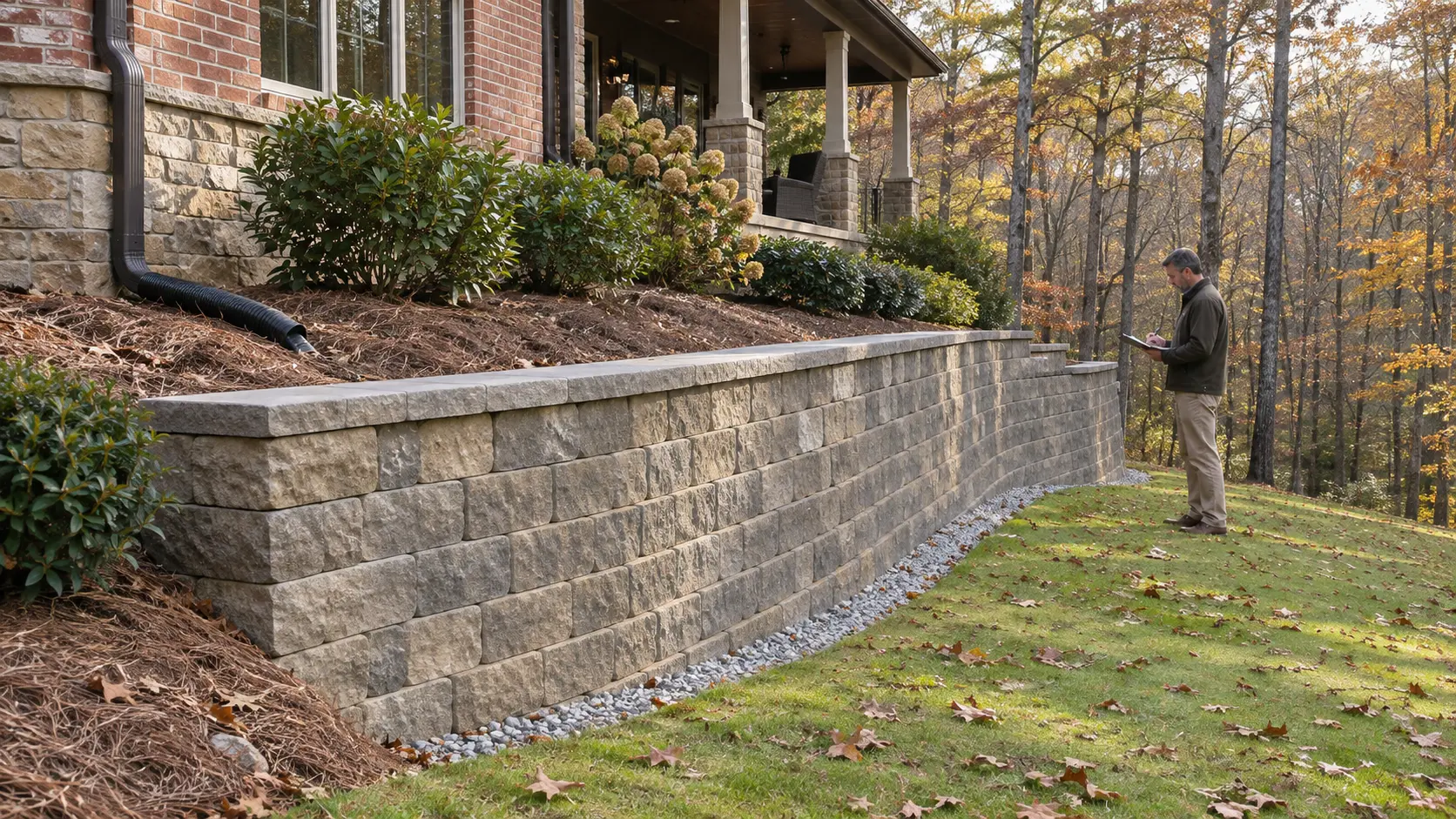
A retaining wall can be a useful part of a North Georgia property, but buyers will want more than a fresh pressure wash and tidy landscaping. Before you list, identify who owns the wall, gather available permits and engineering records, look for changes in the wall or surrounding grade, trace where water goes, and decide whether a qualified specialist should evaluate anything concerning.
The goal is not to promise that a wall is problem-free. It is to understand the property well enough to describe it accurately, support the listing with useful records, and avoid discovering a preventable documentation or condition question in the middle of the buyer’s due-diligence period.
1. Confirm the wall is part of the property you are selling
Start with the recorded plat, a recent survey if one is available, and any closing documents that show easements or common areas. A wall near a side or rear line may sit entirely on one parcel, cross a boundary, or serve more than one property. Its visible face does not, by itself, establish ownership or maintenance responsibility.
If the wall is near an HOA common area, drainage easement, utility easement, septic field, road right-of-way, or neighboring improvement, collect the related documents before assuming who is responsible. When the location is unclear, a Georgia-licensed surveyor can help establish where the wall sits. Our guide to property surveys in Cherokee and Cobb explains why fences, walls, access, and easements deserve address-specific review.
2. Identify the correct permitting jurisdiction
A postal address does not always tell you whether the property is governed by a city or by unincorporated Cherokee or Cobb County. Verify the jurisdiction first, then ask that office what records should exist for a wall of that type, height, age, and location. The correct authority may have different permit, zoning, setback, engineering, or inspection requirements.
For unincorporated Cherokee County, the county currently states that retaining walls 4 feet high or taller need a permit, a site location, and engineered structural drawings. Cherokee also provides an online portal for checking permit status. Cobb County’s current retaining-wall permit application calls for a wall design signed and sealed by a Georgia registered engineer and a site plan showing the wall, elevations, property-line distances, easements, and buffers. Those are useful local reference points, not a substitute for confirming the rule that applies to a particular address.
If you are unsure which government serves the property, begin with our Cherokee and Cobb city-limits checklist.
3. Build a retaining-wall record file
Gather whatever is available, even if the wall predates your ownership:
- permit number, approved site plan, and final inspection or closeout record;
- engineered drawings, calculations, and letters of completion;
- installer or contractor invoices and warranty information;
- repair, drainage, waterproofing, or landscaping receipts;
- photos taken during construction or previous repairs;
- HOA approvals or maintenance provisions; and
- surveys, plats, easements, or agreements that address the wall.
Do not create a conclusion that the records do not support. If a permit search turns up no result, the next step is to ask the correct jurisdiction how older records are stored and what process, if any, applies now. The broader pre-listing permit-record checklist can help you organize renovations and other improvements at the same time.
4. Look for change, not just age
Walk the full length of the wall from a safe position and compare its condition with older photos if you have them. Note leaning, bulging, separated blocks, new or widening cracks, displaced caps, soil loss, exposed reinforcement, settlement near the top, erosion at the ends, or movement in nearby paving and steps.
A single visual clue does not diagnose the cause or tell you whether the wall is structurally unsound. It does tell you what to photograph, document, and discuss with the appropriate professional. Avoid filling cracks, resetting blocks, or covering the area with new landscaping merely to improve appearance before you understand why the change occurred.
5. Trace water from roof to street or swale
Water management is central to a retaining wall. During dry weather, map the path from gutters, downspouts, uphill patios, driveways, irrigation, and neighboring slopes. After ordinary rainfall, observe from a safe location whether water ponds behind the wall, cuts around its ends, washes soil through joints, spills over the top, or erodes the ground at an outlet.
Keep drains and visible outlets accessible for inspection, but do not assume that an opening or pipe proves the complete system is working. Buried drainage, filter fabric, stone backfill, and reinforcement cannot be verified from a listing photo. If the wall interacts with a drainage easement or common stormwater feature, our guide to drainage easements in Cherokee and Cobb offers additional questions to ask.
6. Match the concern to the right professional
Different questions call for different expertise. A home inspector may flag visible conditions in the context of the whole property. A Georgia-licensed professional engineer can evaluate structural design or movement. A surveyor can address location and boundaries. A qualified retaining-wall or drainage contractor can scope work after the cause and design requirements are understood. The county or city can explain its records and permitting process.
Ask for a written scope, findings, and documentation that clearly identify the wall reviewed. If repair work is recommended, confirm whether engineered plans, permits, inspections, or a completion letter will be needed. A verbal assurance is difficult to pass along to a buyer, appraiser, insurer, or future owner.
7. Decide what to address before the listing goes live
Not every seller needs to complete the same work. A well-documented wall with routine landscape maintenance presents a different decision from a wall with visible movement, active erosion, missing records, or unclear ownership. Compare the likely scope, timing, access needs, landscaping impact, and documentation with the planned listing date.
A pre-listing inspection can be one part of that decision, but it does not replace a specialist when the question is structural, drainage-related, or boundary-specific. Coordinate repair and disclosure decisions with your real estate agent and the appropriate qualified professionals. Legal duties and contract strategy are property-specific, so seek legal advice when needed.
8. Describe the wall accurately in the listing and disclosures
Use facts you can support: material, approximate location, documented improvements, available permits, completed engineering review, transferable warranty, or maintenance records. Avoid claims such as “engineered,” “maintenance-free,” “perfect drainage,” or “no issues” unless the documentation clearly supports the statement.
Expect a buyer to inspect the wall, review permits, examine drainage, ask about repairs, and consider its location in relation to boundaries and easements. Clear records do not eliminate buyer questions, but they can make the conversation more organized and reduce avoidable surprises.
A practical pre-listing sequence
- Verify jurisdiction, wall location, and apparent ownership.
- Search for permits, plans, inspections, and completion records.
- Photograph the wall, drainage, grade, and nearby improvements.
- Compare current conditions with older photos and documents.
- Ask the right professional to evaluate unresolved concerns.
- Complete approved work and collect closeout records when appropriate.
- Align the listing description, disclosures, pricing, and showing plan with what is known.
Frequently asked questions
Does every retaining wall need a permit in Cherokee or Cobb County?
Not necessarily. Requirements can depend on the jurisdiction, wall height, design, location, loading, property-line distance, and other site conditions. Verify whether the address is inside a city or in unincorporated county jurisdiction, then ask the correct permitting office. Do not use a neighboring property’s permit history as the answer for your wall.
Should I repair a retaining wall before selling?
That depends on the condition, cause, scope, cost, timing, market positioning, and available documentation. Start with facts and qualified evaluation. Cosmetic work that hides a symptom without addressing the cause can make the transaction harder, not easier.
Can a retaining wall affect a home’s value?
It can contribute useful level yard, driveway, or landscape space, while condition, repair needs, documentation, and market reaction can also affect how a buyer evaluates the property. There is no universal adjustment. A local comparative market analysis and, when relevant, a qualified appraisal can provide property-specific context.
Who should inspect a retaining wall?
A general home inspector can identify visible concerns, but a licensed professional engineer is typically the right resource for structural design, movement, or repair-design questions. Boundary questions belong with a licensed surveyor, and permit questions belong with the city or county that governs the address.
Plan the wall review with the rest of your sale
A retaining wall should be reviewed as part of the whole property: drainage, roof runoff, landscaping, driveway, trees, easements, septic components, permits, and the seller’s timeline. The earlier these pieces are organized, the more choices you usually have about evaluation, repairs, documentation, and listing presentation.
Planning to sell a home with a retaining wall in Cherokee County, Cobb County, or nearby North Georgia? Carol can help you organize the property questions, records, specialist timing, and listing strategy around your goals. Schedule a West Legacy Realty consultation.
This article provides general real estate information, not engineering, surveying, legal, insurance, or construction advice. Permit requirements, wall ownership, site conditions, contract duties, and repair needs vary by property and jurisdiction.