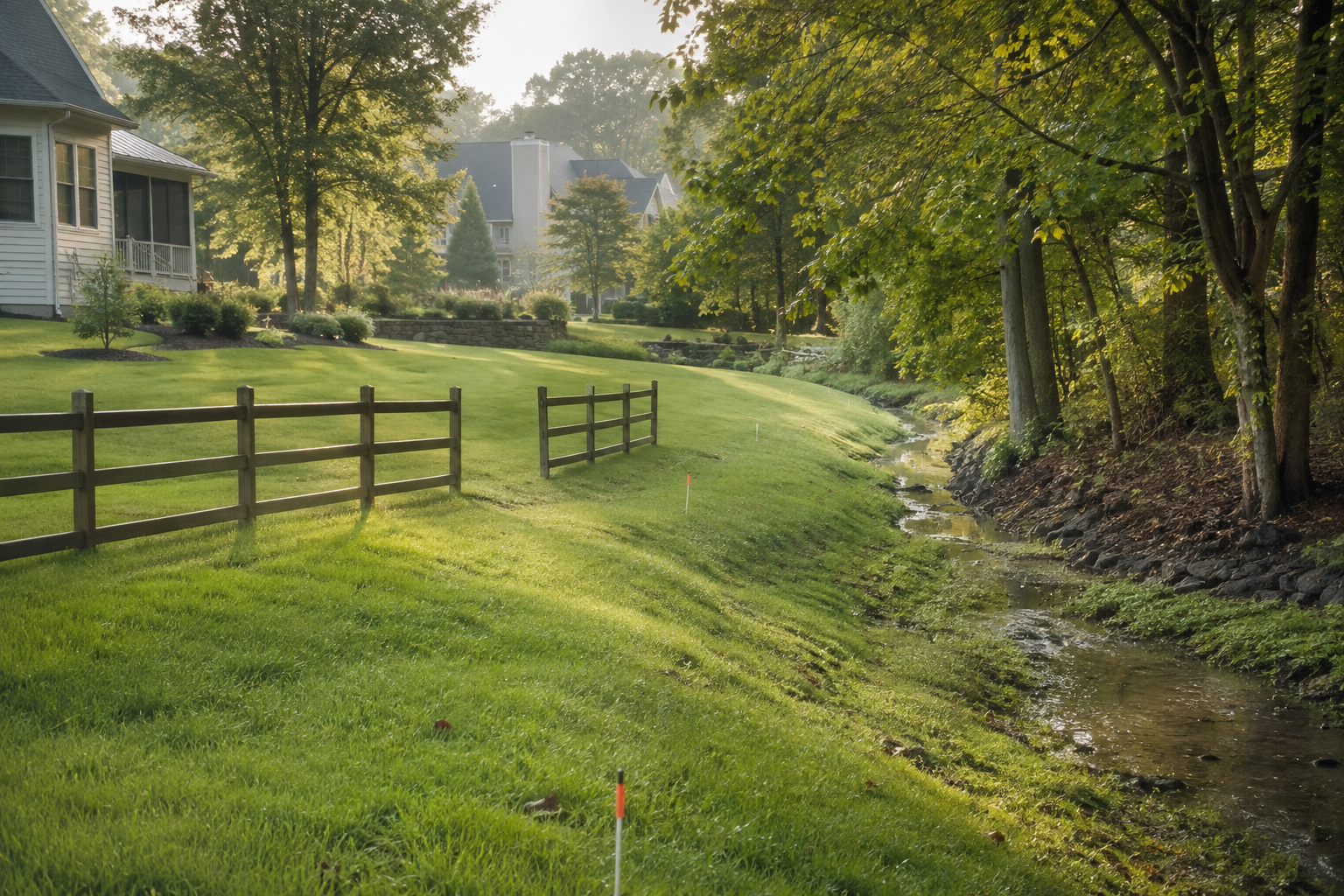
If there is a drainage easement, creek corridor, or open swale on your lot in Cherokee County or Cobb County, it is worth slowing down before you add a fence, bring in fill dirt, or reshape the backyard.
The short answer is this: both counties expect property owners to keep drainage areas clear, and both counties limit what owners should change without checking the rules first. That matters whether you are trying to make the yard more usable, planning a pre-listing refresh, or simply figuring out what you actually own versus what you are responsible to maintain.
If you want help weighing a property, a future sale, or a move within North Georgia, start a conversation with Carol here.
What a drainage easement usually means for a homeowner
A drainage easement is not the same thing as extra private yard space you can treat any way you want. In practical terms, it is a legal path for stormwater to move through or across a property. That path may look like an open ditch, a small creek corridor, a swale, a drainage pipe area, or land around a detention feature.
Cobb County says most drainage easements are at least 20 feet wide and exist to preserve stormwater conveyance away from homes and other structures. Cherokee County says owners of property with drainage features such as ponds, pipes, ditches, and creeks are responsible for routine maintenance and that the county does not assist with maintenance on private property beyond the right of way.
That does not automatically mean a lot is a problem lot. It means backyard projects deserve a due-diligence step before money gets spent.
Why homeowners get tripped up here
Many drainage easements do not look dramatic on a sunny day. They can read like unused grass, a tree line, a low area behind the fence, or a strip of land that seems perfect for extending the yard. Then a project starts, a contractor proposes a change, or a future buyer asks questions, and the owner realizes the area has different rules than the rest of the lot.
This is especially common in Cherokee and Cobb neighborhoods with sloped lots, creek corridors, older subdivision drainage patterns, or homes where the usable backyard feels smaller than the survey line suggests.
What Cherokee County says
Cherokee County’s drainage easement policy says the county does not maintain drainage easements outside county right of way and that drainage easements are dedicated to public use but are not accepted for county maintenance. The county also says the property owner must keep drainage easements free of obstruction and must not alter drainage improvements without prior written approval from the Cherokee County Engineering Department.
That last point is the one many homeowners miss. A backyard project can feel minor from a landscaping perspective and still count as an alteration from a drainage perspective.
What Cobb County says
Cobb County says drainage easements preserve a legal path for stormwater conveyance and that the individual property owner is responsible for maintaining open drainage easements in an open, unobstructed condition. Cobb also says no dumping of yard debris, filling with soil or concrete, or fencing is permitted within a drainage easement.
Cobb further explains that public maintenance responsibility is limited to drainage structures that were formally dedicated to and accepted by the county. In other words, many of the day-to-day issues owners notice in the backyard are still private-property responsibilities even when the area serves a broader drainage purpose.
5 questions to ask before you fence, fill, or landscape
1. Where is the easement actually located?
Start with the survey, plat, and any recorded documents you received at closing. Cherokee County’s drainage easement FAQ also points owners to county GIS and final plat research tools. If the area is not clear on the paperwork you already have, get clarity before a contractor starts laying out a project.
2. Is this project changing stormwater flow or blocking access?
Fences, retaining edges, fill dirt, sheds, play sets, garden beds, and heavy landscaping can all change how water moves or how the area can be maintained. Even when a project looks attractive, it may create a future maintenance problem or conflict with county rules.
3. Does the lot deserve a flood-map check too?
If the easement connects to a creek, low area, or mapped drainage corridor, check the floodplain context as part of the same review. Cherokee County’s floodplain page directs residents to FEMA’s Flood Map Service Center and county GIS resources, and FEMA identifies the Map Service Center as the official public source for flood hazard information. A drainage easement is not the same thing as a floodplain, but the two can overlap in ways that affect future plans.
4. Are you improving the yard for your own use, or getting it ready to sell?
If the goal is resale, pause before sinking money into a project that a buyer, inspector, or county reviewer may question later. In some cases, the better move is cleanup, mowing, selective pruning, and documentation rather than a bigger installation. If the project is part of a wider move-out reset, this local cleanup guide can also help: Moving Soon in Cherokee or Cobb County? Where to Take Paint, Electronics, Cardboard, and Bulky Items.
5. Who should review the plan before work starts?
Sometimes the right next step is a quick county question. Sometimes it is a survey review, contractor revision, or engineering input. The point is not to overcomplicate every backyard update. The point is to check the few projects that could create a more expensive problem later.
What not to assume
Do not assume a previous owner handled everything correctly just because a fence, wall, or landscaping is already there. Do not assume the county maintains a drainage area just because water from other properties passes through it. And do not assume a contractor’s generic “we do this all the time” answer is enough when the lot has a recorded easement or a visible drainage path.
Homeowners usually do better when they treat drainage questions as both a property-use issue and a future-marketability issue.
A simple homeowner checklist
- Pull the survey, plat, and closing documents before planning the project.
- Identify whether the area includes an open swale, creek, pipe corridor, pond edge, or other drainage feature.
- Check county guidance before fencing, filling, or altering the area.
- Use FEMA and county floodplain tools when the location raises a broader water-risk question.
- Keep records of any approvals, contractor scope, and site changes for future buyers.
Why this matters for resale too
Backyard usability matters in Cherokee County, Cobb County, and nearby North Georgia markets. So does confidence. A buyer who sees a creek edge, swale, or easement line will often want to know what can be built there, who maintains it, and whether the current setup was done the right way.
If you are preparing a property for the market, the cleanest path is usually the one that improves function and presentation without creating new questions. Our guide on drainage checks before buying a North Georgia home with a basement is useful if the lot also sends water toward lower-level living space. Homeowners who recently closed on a home in the area may also want our post on post-closing property tax steps in Cherokee and Cobb County. Sellers planning broader prep work should also review Planning to Sell in Cherokee or Cobb County? Check These Permit Records Before You List.
FAQ
Can I put a fence in a drainage easement in Cobb County?
Cobb County says fencing is not permitted within a drainage easement. Owners should verify the easement location before planning a fence extension or backyard enclosure.
Does Cherokee County maintain drainage easements on private property?
Cherokee County says it does not maintain drainage easements outside county right of way and does not assist with maintenance on private property.
Is a drainage easement the same thing as a floodplain?
No. They are different concepts, although they can overlap on the same property. That is why a flood-map check can still be useful when the lot includes a visible drainage feature.
Should I avoid a home or lot because it has a drainage easement?
Not automatically. The better question is whether you understand the maintenance duties, project limitations, and resale implications before you make changes or move forward with a purchase.
The next step
A backyard project can be a value add, a maintenance shortcut, or a future headache depending on the lot and the rules. If you are buying, selling, or planning around a tricky yard feature in Cherokee County, Cobb County, or another North Georgia area, use Carol’s consultation form here to talk through the next step.
Sources: Cherokee County Stormwater Management drainage easement policy and floodplain information pages; Cobb County Stormwater Infrastructure Maintenance and Easement guidance; FEMA Flood Map Service Center.