Yes, a North Georgia homebuyer should discuss radon testing early enough to complete the test and any follow-up before the due-diligence deadline. Radon is invisible and odorless, and neighboring homes can produce different results. A finished basement, slab home, crawlspace, new build, or older home cannot be cleared by appearance alone. The only way to know the level in a specific home is to test.
Georgia public-health guidance says radon is more common in northern Georgia because of the region’s geology and soil composition, especially around Metro Atlanta. That does not mean every Cherokee County or Cobb County home has an elevated level. It means address-specific testing is more useful than assumptions based on the neighborhood, foundation type, or a county map.
1. Ask whether the home has been tested before
Start by requesting any prior radon reports and mitigation records. A useful report should help answer:
- When was the test performed?
- Who conducted it and what device was used?
- Where in the home was the device placed?
- How long did the test run?
- Were closed-house and other required conditions followed?
- Has the foundation, HVAC system, or lower level changed since then?
The U.S. Environmental Protection Agency says a buyer may reasonably ask for a new test when the prior result is not recent, testing conditions were not documented, the home has been altered, or the buyer plans to occupy a lower level that was not tested. A seller’s report can be valuable, but the date, location, method, and condition of the home matter.
2. Test the lowest level that could be used regularly
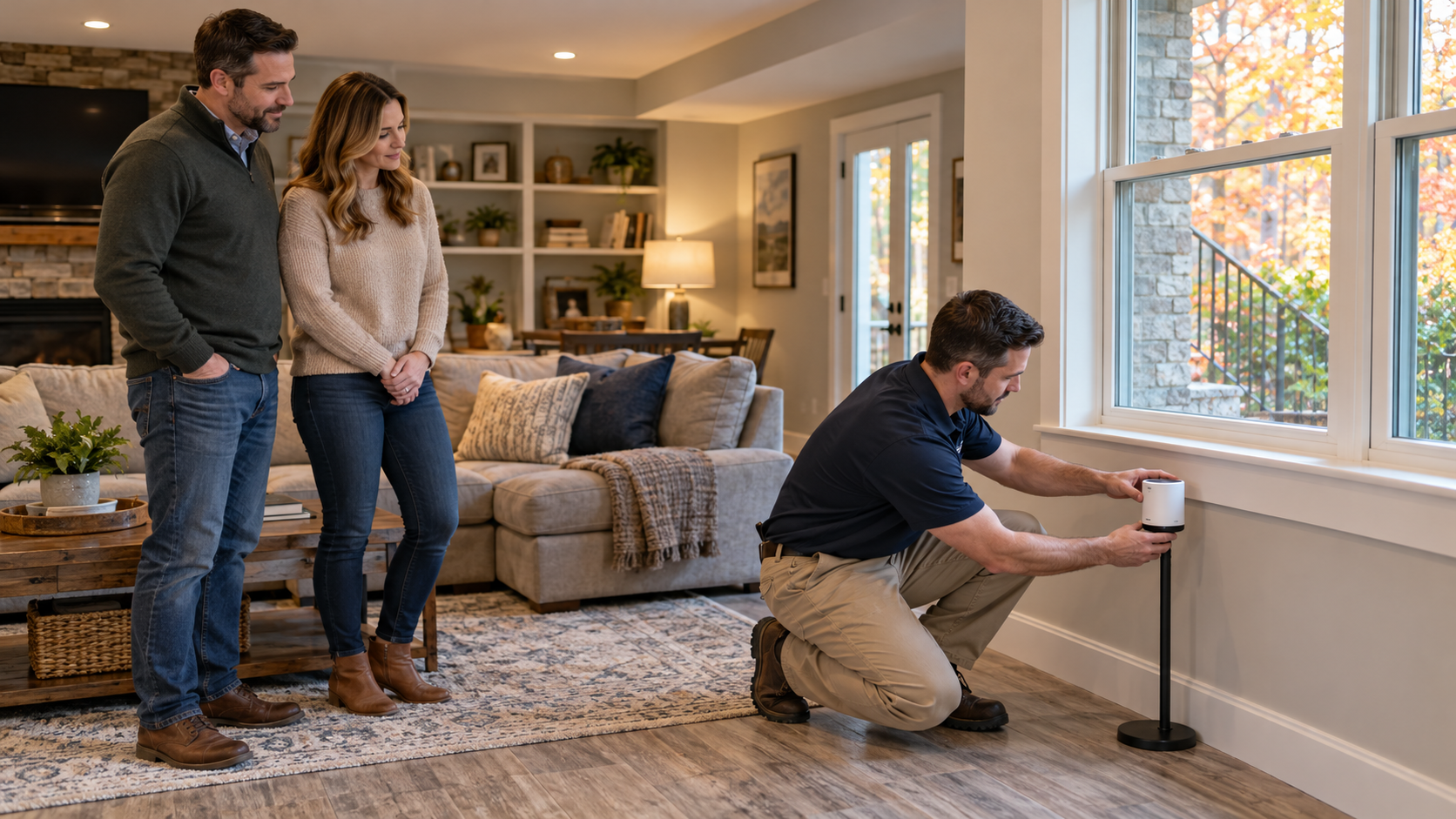
For a real-estate decision, the EPA recommends testing the lowest level of the home that could be used regularly, whether it is finished or unfinished. That detail matters in North Georgia, where terrace levels and basements may serve as bedrooms, offices, gyms, playrooms, guest suites, or future finished space.
Do not place a device wherever it is least disruptive. Follow the device instructions or the qualified tester’s protocol for height, airflow, exterior walls, humidity, and distance from windows, doors, vents, kitchens, bathrooms, and other unsuitable locations.
If a lower level is important to a multigenerational plan, our guide to buying a multigenerational home in North Georgia can help you connect air-quality testing with layout, permits, privacy, and system capacity.
3. Put the test plan on the contract calendar
Radon testing is most useful when the schedule leaves time to receive the result, evaluate it, obtain qualified advice, and decide how to proceed under the contract. Discuss these questions at the beginning of due diligence:
- Who will perform or manage the test?
- Which device and test duration fit the transaction?
- Where will the device be placed?
- Who will receive the report?
- What happens if the device is disturbed or conditions are not maintained?
- How much time remains for confirmation testing or mitigation estimates?
Georgia does not currently mandate radon testing for real-estate transactions, according to the UGA Radon Program. A voluntary test still gives the parties property-specific information. Contract language, disclosure duties, inspection rights, and remedies depend on the documents and circumstances, so obtain appropriate real-estate and legal guidance.
4. Protect the test conditions
A result is only as useful as the test process. Short-term testing typically requires controlled conditions, which may include keeping exterior windows closed and limiting exterior-door opening to normal entry and exit. Heating and cooling should generally operate as directed rather than being changed to influence airflow.
The EPA’s testing checklist also addresses device placement, minimum test duration, severe weather, interference, and documentation. A qualified tester may use a monitor that records environmental changes or possible disturbance during a real-estate test.
Buyers and sellers should understand the instructions before the device is placed. If conditions are violated, document the issue and ask the tester whether the result is valid or whether a new test is needed.
5. Choose the right tester or device for the situation
Home test kits can be appropriate for general homeowner screening when their instructions are followed carefully. UGA Extension offers short-term kits and instructions for Georgia residents. A time-sensitive real-estate transaction may benefit from a certified professional who can place a calibrated device, document conditions, and return results within the contract schedule.
Ask about the tester’s credentials, device, quality-control process, turnaround time, report format, and what happens if the reading is close to or above an action threshold. UGA points Georgia consumers to the National Radon Proficiency Program and the National Radon Safety Board for certified professionals.
6. Interpret the result without panic or dismissal
Radon is measured in picocuries per liter of air, written pCi/L. The EPA recommends taking action to reduce a home’s radon level when the result is 4 pCi/L or higher and notes that there is no known safe level of radon exposure. UGA guidance also describes 4 pCi/L as the level that triggers recommended follow-up and professional mitigation planning.
One number still needs context. Review the device, test duration, placement, conditions, and any recommended confirmation testing. Do not dismiss a result because a nearby house tested lower, and do not assume that a single short-term result describes every season. A qualified radon professional can explain the next testing or mitigation step.
7. Understand mitigation before deciding what the result means
An elevated result does not automatically make a home unusable. The EPA says high radon levels can be reduced. A common approach uses a vent pipe and fan to draw radon from beneath a slab or crawlspace and discharge it safely outdoors, but the correct design depends on the home.
If a mitigation system already exists, ask for installation documents, service information, fan and alarm details, prior and post-mitigation test results, and the location of the discharge point. Confirm that the system is operating, then discuss retesting with a qualified professional.
For a proposed system, obtain an evaluation and written estimate from a qualified mitigator. Clarify electrical needs, pipe routing, exterior appearance, fan location, warranty, monitoring, and post-installation testing. Sealing foundation openings may be part of a system, but the EPA does not recommend relying on sealing alone as the primary radon-reduction method.
8. Revisit radon after construction or a change in use
A prior low test is not a lifetime certificate. EPA guidance recommends considering a new test after significant renovation or HVAC changes, and when occupants begin using a lower level that was not previously tested. That could apply after finishing a basement, creating a bedroom or office, changing ventilation, or altering the foundation.
For new construction, ask the builder whether radon-resistant features were installed and request the relevant documentation. Those features do not replace a completed-home test. Add radon documentation to the same closeout file you use for warranties, permits, inspections, and punch-list work. Our new-construction final-walkthrough guide offers a broader checklist for that process.
North Georgia radon checklist for buyers
- Request prior radon reports and mitigation records.
- Check the date, tester, device, duration, placement, and test conditions.
- Test the lowest level that could be used regularly.
- Choose a device or certified professional that fits the due-diligence timeline.
- Maintain and document the required testing conditions.
- Review the result with EPA and Georgia guidance.
- Obtain qualified follow-up testing or mitigation advice when indicated.
- Plan to retest after mitigation, major renovations, or a change in lower-level use.
Frequently asked questions
Can you tell whether a home has radon by its age or foundation?
No. Radon can enter different types and ages of homes, and levels can vary between neighboring properties. Testing is the only way to know the level in a specific home.
Is radon testing required when buying a home in Georgia?
UGA’s Radon Program says Georgia does not currently mandate radon testing or certification for real-estate transactions. Buyers can still make testing part of their due-diligence plan, subject to the contract and professional advice.
Should a finished basement be tested?
Yes, if it is the lowest level that could be used regularly. The EPA specifically directs buyers to consider the lowest level they may use as living space, whether finished or unfinished.
What if the test result is 4 pCi/L or higher?
The EPA recommends action to reduce the level at 4 pCi/L or higher. Review the test validity and follow-up recommendations with a qualified radon professional, then address timing and decisions within the real-estate contract.
Does a mitigation system mean the home still has a problem?
A system is evidence that radon was addressed, not proof that current levels are high or low. Review its documentation and operation and obtain current testing as appropriate.
Build radon testing into the property plan
A radon test is a small task with an important scheduling consequence: it must start soon enough to produce reliable information while the buyer still has time to respond. If you are comparing homes in Cherokee County, Cobb County, or elsewhere in North Georgia, schedule a consultation with Carol West to coordinate the home search, inspections, test timing, and contract deadlines around the property you are considering.
This article provides general real-estate and homeowner education, not medical, environmental, engineering, legal, or inspection advice. Radon conditions, test protocols, contract rights, and mitigation needs vary. Follow the device instructions and current guidance from qualified radon professionals, public-health authorities, and your legal and real-estate advisors.