
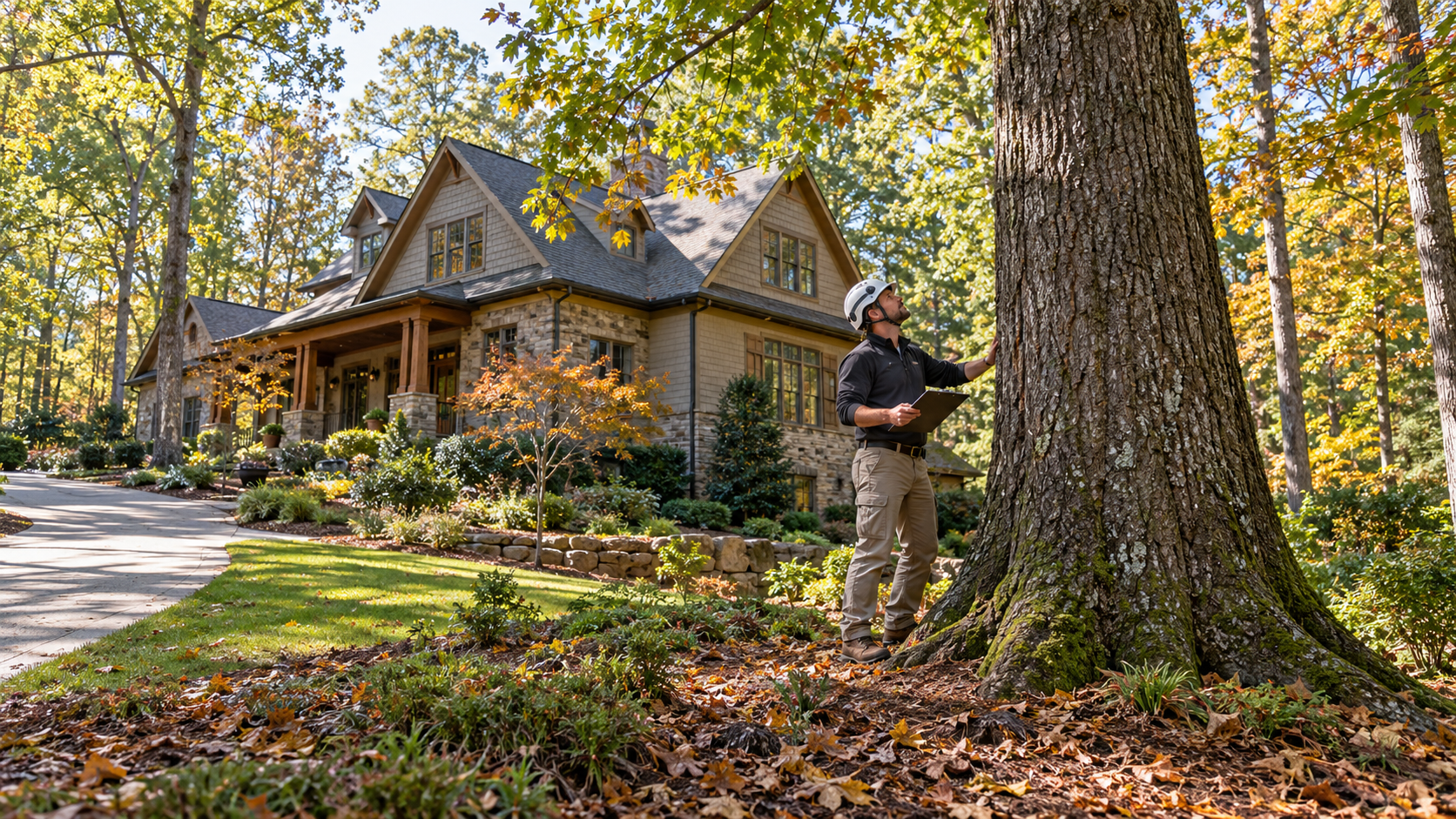
When buying a home with mature trees in North Georgia, look beyond shade and curb appeal. Check the canopy, trunk, root zone, distance from the house, driveway and utilities, then bring in a qualified arborist when a tree’s health or structure is uncertain. The goal is not to label every large tree a problem. It is to understand which trees are assets, which need routine care, and which questions belong in your due-diligence plan.
Mature hardwoods are part of the character of many Cherokee County and Cobb County properties. They can frame a home, cool outdoor spaces, and make an established lot feel distinctive. They can also interact with roofs, foundations, pavement, drainage, utility lines, septic areas, fences, and neighboring property. A general home inspection may flag visible concerns, but a certified arborist is the appropriate professional to evaluate tree health, structure, and risk.
1. View the whole tree, not just the trunk
Start far enough away to see the tree from the ground to the top of the canopy. Look at its overall shape, whether the crown appears balanced, and what would be below a falling branch. A large tree in an open corner of an acreage lot presents a different set of questions from a tree over a roof, driveway, play area, parking space, or frequently used walkway.
UGA Extension identifies dead or hanging branches, cracks, cavities, dieback, decay signs, and unusual leaning with soil disturbance as reasons for closer attention. These observations are screening questions, not a do-it-yourself diagnosis. Tree species, growth pattern, season, past pruning, soil, weather, and site changes all affect what you see.
During autumn, remember that normal leaf drop can make a healthy deciduous tree look sparse. Compare the whole canopy and nearby trees of the same type, then ask a qualified arborist about anything that appears inconsistent.
2. Look for dead, broken, or lodged branches
Scan major limbs, branch unions, and the canopy above areas people or vehicles use. Dead wood may lack bark, buds, or smaller twigs. A broken branch can remain lodged in the crown after it has already failed. The U.S. Forest Service notes that dead and lodged branches can fall as weather and support conditions change.
From the ground, document concerns with clear photos and their locations. Do not climb the tree, stand beneath questionable limbs, or attempt high pruning during a showing or inspection. Ask the seller whether storm cleanup, large-limb removal, cabling, or other professional tree work has been completed and whether invoices or reports are available.
3. Check the trunk and major branch unions
Walk around the tree at a safe distance and look for visible cracks, open cavities, loose bark, large old pruning wounds, mushrooms or conks, and areas that appear soft or decayed. Multi-stem trees and tight forks may deserve a closer look because included bark or decay can weaken the connection between stems.
A hollow-looking area does not tell you, by itself, whether a tree is stable. Likewise, green leaves do not rule out a structural defect. Avoid probing, drilling, cutting, or pulling away bark. A qualified arborist can determine whether a visual assessment is enough or whether specialized evaluation is appropriate.
4. Examine the root flare and surrounding soil
The trunk should widen where it meets the ground. Excess soil or mulch piled against the trunk can hide the root flare and retain moisture against the bark. Surface roots are common in mature landscapes, but they should be reviewed in context with erosion, soil compaction, pavement, and prior construction.
Look for fresh soil cracks, lifting ground, severed roots, recent trenching, grade changes, vehicles parked over the root zone, or heavy construction close to the tree. UGA Extension explains that root damage and compacted soil can affect stability and long-term health. Roots often extend well beyond the visible canopy edge, so a tree can be affected by work that is not directly beside the trunk.
If the lot has visible drainage features or low areas, review our guide to drainage easements in Cherokee and Cobb County. Tree roots, erosion controls, access rights, and future landscaping plans should be considered together.
5. Measure clearance from the roof, driveway, and structures
Note branches touching or hanging over the roof, chimney, gutters, service lines, decks, sheds, fences, and neighboring improvements. The question is not simply whether a branch crosses an imaginary vertical line. Consider species, branch condition, growth direction, wind exposure, and the amount of clearance needed for maintenance.
Also look down. Raised pavement, cracked walkways, displaced retaining materials, and recurring gutter debris can reveal ongoing maintenance questions. Tree roots do not automatically prove the cause of a foundation or pavement issue, so avoid jumping from correlation to diagnosis. Bring the appropriate arborist, inspector, engineer, roofer, drainage professional, or contractor into the conversation based on the evidence.
6. Confirm where the tree and boundaries are
A trunk near a property line can create practical questions about ownership, access, pruning, debris, and shared concerns. Do not rely on fences, mowing patterns, landscaping beds, or an online parcel map as a precise boundary.
Ask whether a current survey is available and whether the title work identifies relevant easements. Our guide on when to order a property survey before buying explains how boundaries, fences, access, and improvements can affect the decision.
UGA Extension provides general information about tree ownership and responsibility in Georgia, but a specific dispute or proposed cutting plan can involve property and legal questions. Obtain legal advice when ownership, damage, notice, or rights are unclear.
7. Ask about tree-work history and known concerns
Useful records can include arborist reports, pruning and removal invoices, stump-grinding records, storm-damage repairs, pest or disease treatments, cabling or bracing documentation, and notices or correspondence about a tree. Ask what prompted the work and whether follow-up was recommended.
Records matter because a freshly cleaned yard can hide the history that would otherwise help a buyer understand the property. They can also help a new owner maintain valuable trees correctly instead of starting over with incomplete information.
If a seller has received a written concern about a tree, the legal implications depend on the facts. UGA’s tree-ownership guidance discusses how prior knowledge may matter under Georgia law, but buyers and sellers should not use a general article as a substitute for legal advice.
8. Check utilities, septic areas, and future projects
Before planning an addition, pool, detached building, widened driveway, fence, major grading, or utility trench, compare the project area with the trees and their root zones. Construction traffic, soil compaction, excavation, and grade changes can damage roots even when the trunk remains untouched.
For properties with septic systems, locate the tank, drain field, and service access before assuming a tree can remain, be removed, or be replaced nearby. For overhead utility lines, contact the utility about line-clearance work. Do not hire someone to work close to energized lines without the proper qualifications and coordination.
Tree removal, land disturbance, and replacement requirements can vary by municipality, unincorporated county area, subdivision, and HOA. Verify the property’s exact jurisdiction and current rules before approving work. A Canton, Woodstock, Marietta, Acworth, Kennesaw, or unincorporated-county address should not be treated as interchangeable.
9. Budget from written, property-specific advice
If a tree raises a concern, ask a qualified arborist for a written scope. The recommendation may be monitoring, selective pruning, soil or root-zone protection, treatment, cabling, or removal. It may also be that no immediate work is needed.
Compare credentials, insurance, scope, cleanup, access needs, protection for the home and landscape, stump handling, and whether permits or utility coordination apply. Avoid using an unverified online average as a property budget; tree size, condition, equipment access, nearby structures, traffic control, and disposal requirements can materially change the work.
Property-specific insurance questions belong with a licensed insurance professional. Our guide to getting a home insurance quote before due diligence ends can help buyers connect property details with coverage, deductibles, and the estimated monthly cost.
Mature-tree checklist for North Georgia homebuyers
- View each significant tree from the ground to the full canopy.
- Note what people, vehicles, roofs, utilities, and structures are within reach.
- Look for dead, broken, or lodged branches.
- Document cracks, cavities, decay signs, dieback, or unusual leaning.
- Check the root flare, soil, erosion, grade changes, and construction history.
- Measure practical clearance from roofs, chimneys, gutters, pavement, and service lines.
- Confirm boundaries, easements, septic areas, and the property’s jurisdiction.
- Request arborist reports, work invoices, and known-concern records.
- Obtain qualified written advice before assigning a repair scope or budget.
Frequently asked questions
Should a home inspector evaluate the trees?
A home inspector may note visible conditions that affect the house or property, but tree health, structure, and risk are specialized questions. When mature trees are close to important targets or show concerning conditions, ask a certified arborist for a property-specific assessment.
Does a leaning tree always need to be removed?
No. Some trees develop a stable lean as they grow. A new or changing lean, especially with soil cracking, root movement, decay, or a target in the possible fall path, deserves prompt professional evaluation.
Are surface roots automatically a foundation problem?
No. Surface roots are common and do not prove the cause of a structural issue. Review the tree, soil, drainage, pavement, and building condition with the right professionals before drawing a conclusion.
Who owns a tree near the property line?
Ownership can depend on the tree’s location and the applicable facts. A fence or landscaping pattern is not a substitute for a survey. Use a surveyor for boundary questions and obtain legal advice for a specific ownership or responsibility dispute.
Is fall a good time to evaluate mature trees?
Fall can make branch structure easier to see as leaves drop, but seasonal appearance varies by species. A qualified arborist can distinguish normal seasonal change from dieback, disease, structural defects, or root problems.
Make the trees part of the property decision
A wooded lot should not be reduced to either “beautiful” or “risky.” The better approach is property-specific: identify the trees that shape daily use, document visible concerns, verify boundaries and planned work, and bring in qualified advice while the contract schedule still allows informed decisions.
If you are comparing homes in Cherokee County, Cobb County, or elsewhere in North Georgia, schedule a consultation with Carol West to coordinate the home search, inspections, specialist access, records, and due-diligence timeline around the property you are considering.
This article provides general real-estate and homeowner education, not arboricultural, engineering, insurance, environmental, or legal advice. Tree conditions, ownership, risk, permit requirements, and contract rights vary by property and jurisdiction. Consult qualified professionals and current local requirements for the specific home.