
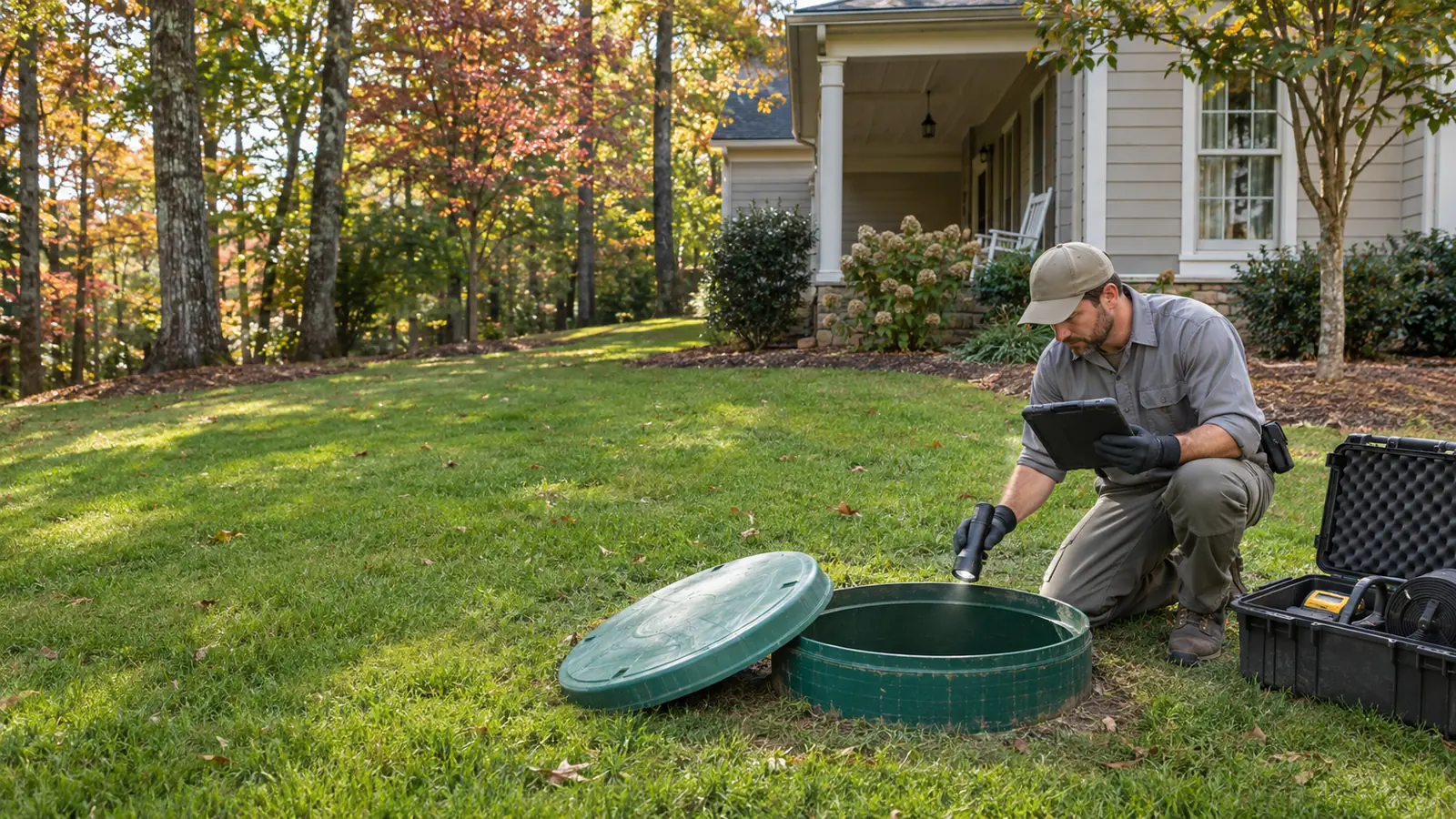
If you are selling a North Georgia home with a septic system, start before the listing goes live: identify the system, request available county records, organize maintenance history, walk the yard for visible concerns, and decide with qualified professionals whether any service or inspection is appropriate. The goal is not to promise a problem-free system. It is to replace avoidable uncertainty with accurate records, clear access, and a practical plan for buyer due diligence.
This preparation matters in Cherokee County, Cobb County, and nearby communities where homes on larger, wooded, or less centrally served lots may use on-site sewage management. A septic system treats and disposes of household wastewater on the property, so buyers often want to understand its location, permitted design, service history, condition, and relationship to future yard plans.
What should a seller do before listing a home with a septic system?
Gather the permit or system drawing, installation and repair records, pumping receipts, inspection reports, and any service agreement. Confirm which local Environmental Health office holds the property records. Then review access to the tank, the drainfield area, recent changes to the home or yard, and the timing of any inspection with your real estate professional and a Georgia-certified septic contractor. Keep marketing language factual and disclose known information through the appropriate transaction documents.
1. Confirm what serves the property
Do not assume that a rural-looking property is on septic or that a home near a public sewer line is connected to it. Start with utility bills, seller records, prior closing documents, the property survey, and the local Environmental Health office. Confirm whether the home uses a conventional septic system, an alternative system with mechanical components, public sewer, or another approved arrangement.
Also note which structures contribute wastewater. A finished basement, guest suite, detached living space, or later addition may raise questions about the system’s permitted design and current use. Avoid drawing conclusions from bedroom count or visible plumbing alone. The property-specific permit and professional evaluation are more useful than assumptions.
2. Request the permit, drawing, and available public records
A septic drawing can help show the documented tank and drainfield location, but the actual site should still be verified. In Cherokee County, the North Georgia Health District says its Environmental Health offices can help property owners find a septic drawing and answer general system questions. Its guidance also states that permits are required for new systems, additions, modifications, and repairs.
For a Cobb County property, Cobb & Douglas Public Health provides an Environmental Assessment Record Request for septic-system and related property records. Record availability and response timing vary, so request documents early rather than waiting for a buyer’s due-diligence period.
If the home has undergone renovations, compare the septic file with building and permit history. Our guide to checking permit records before selling in Cherokee or Cobb explains how to organize contractor, approval, and completion documents without treating a record search as a substitute for a current inspection.
3. Build a clear service and repair timeline
Collect pumping receipts, inspection reports, repair invoices, installer information, warranty documents, alarm or control-panel service, and correspondence with Environmental Health. Put the records in date order and label what work was actually performed. A pumping invoice, for example, does not necessarily document the condition of every component or the drainfield.
The Georgia Department of Public Health maintains state on-site sewage resources, including current lists of certified pumpers and installers. Use properly qualified providers for work that requires certification, and confirm the scope of any visit in writing.
Do not invent a service date, describe routine pumping as a full inspection, or advertise a repair as a complete replacement unless the documents support that language. If records are missing, say what is known and ask the appropriate office or contractor what can be verified.
4. Walk the house and yard for visible questions
Before photography and showings, look at the property as a buyer and inspector may see it. Note slow drains, repeated backups, sewage odors, unusually wet areas, standing water, bright or dense vegetation over part of the yard, damaged risers or lids, active alarms, erosion, and evidence of vehicles or heavy equipment crossing the system area.
These observations do not diagnose a septic problem. Weather, plumbing, grading, irrigation, and other conditions can produce similar signs. Document what you observe, avoid opening or entering a tank, and ask a qualified septic professional or plumber to evaluate concerns within the right scope.
If the home also uses a private well, prepare the two systems together. Our North Georgia well-water seller guide covers testing, records, equipment, lender questions, and access planning.
5. Protect access and explain the usable yard
Locate the documented tank, access points, drainfield, and replacement area if one is shown. Clear light vegetation that blocks authorized access, but do not excavate, remove covers, drive stakes, or alter the system without qualified guidance. Keep vehicles, storage containers, construction materials, and heavy equipment away from the system area.
Think beyond the current sale. Buyers may be considering a pool, workshop, addition, driveway change, patio, retaining wall, or major landscaping. A septic layout can affect where those projects are feasible. Do not promise that a future improvement will be approved. Encourage buyers to verify their plans with Environmental Health and the other relevant authorities.
6. Decide how to handle pre-listing service or inspection
There is no single service plan that fits every property. System type, age, household use, last pumping date, known concerns, local requirements, buyer expectations, and contract terms can all affect timing. Ask a certified provider what its inspection or service includes and whether the tank must be pumped for the requested scope.
A pre-listing evaluation can give a seller more time to understand findings and gather estimates, but it can also create new information that must be handled accurately. Coordinate the decision with your agent before ordering work. The same principle applies to a broader pre-listing home inspection: define the purpose, scope, access, reporting, and response plan first.
If service is completed, retain the invoice, report, photos, contractor certification information, and any permit or approval connected to repair work. Avoid saying the system “passed” unless the professional’s actual report uses that conclusion for the stated scope.
7. Prepare accurate disclosure and listing language
Answer property-disclosure questions truthfully and completely based on what you know, the documents you have, and advice from the professionals involved in the transaction. Relevant facts may include known failures, backups, repairs, alternative-system service requirements, shared components, unpermitted changes, or unresolved recommendations. Disclosure duties and contract obligations are fact-specific, so legal questions belong with a Georgia real estate attorney.
Marketing should be just as precise. “Septic records available,” “pumped in 2025,” or “alternative system under service agreement” may be supportable when documentation exists. Broad claims such as “maintenance-free,” “new septic,” or “approved for expansion” can mislead if they go beyond the records.
8. Create a buyer handoff folder
Give the eventual buyer an organized set of documents rather than a pile of unrelated receipts. Include available permits and drawings, service and pumping history, repair approvals, warranties, operating instructions, provider contacts, alarm information, and a simple note identifying access points. Remove private account credentials, payment details, and unrelated personal information.
The Metropolitan North Georgia Water Planning District recommends keeping septic maintenance information with the home’s records because it is useful when problems arise or the home is sold. A clear handoff helps the next owner understand routine care without implying that past maintenance guarantees future performance.
Septic-system seller checklist
- Confirm whether the property is on septic and identify the system type.
- Request the permit, drawing, installation record, and repair history.
- Organize pumping, inspection, maintenance, and warranty documents.
- Walk the house and yard for visible questions that need professional follow-up.
- Protect access to the tank and drainfield and avoid heavy loads over the system.
- Choose any pre-listing service or inspection scope with qualified guidance.
- Use accurate disclosure and marketing language supported by records.
- Prepare a clean buyer handoff folder before closing.
Frequently asked questions
Must a seller pump the septic tank before listing?
Not in every transaction. The appropriate timing depends on the system, service history, local requirements, provider’s inspection scope, buyer request, and purchase agreement. Confirm the property-specific plan with your real estate professional, local Environmental Health office, and a certified septic provider.
What if the county cannot find the original septic record?
An unavailable record does not prove that a system is acceptable or defective. Ask the local office what other records exist and what process applies to the property. A qualified professional may be able to locate components and recommend the right evaluation, but do not recreate or guess at an official drawing.
Can a seller promise room for a pool or addition?
Not based only on open yard space. The active drainfield, replacement area, setbacks, soils, slope, utilities, zoning, stormwater, and building rules may all matter. A buyer should verify a proposed project with the relevant authorities and professionals before relying on feasibility.
Does a recent pumping receipt mean the system is in good condition?
No. It documents a service event and whatever scope the invoice or report states. It may not evaluate the tank, piping, distribution components, drainfield, hydraulic performance, or future life of the system.
Make septic preparation part of the listing plan
A seller does not need to turn a septic system into a sales pitch. The stronger approach is quieter: know what serves the home, gather reliable records, make the system accessible, investigate visible concerns, and give buyers accurate information at the right time.
Planning to sell a septic-system home in Cherokee County, Cobb County, or nearby North Georgia? Carol can help you coordinate the record requests, pre-listing decisions, disclosure questions, showing preparation, and buyer due-diligence timeline. Schedule a West Legacy Realty consultation.
This article provides general real-estate and homeowner information, not legal, environmental-health, engineering, plumbing, septic-design, or inspection advice. Records, permits, system designs, service needs, disclosure duties, and transaction terms vary by property and jurisdiction. Confirm current requirements and property-specific conditions with the appropriate local office and qualified professionals.