
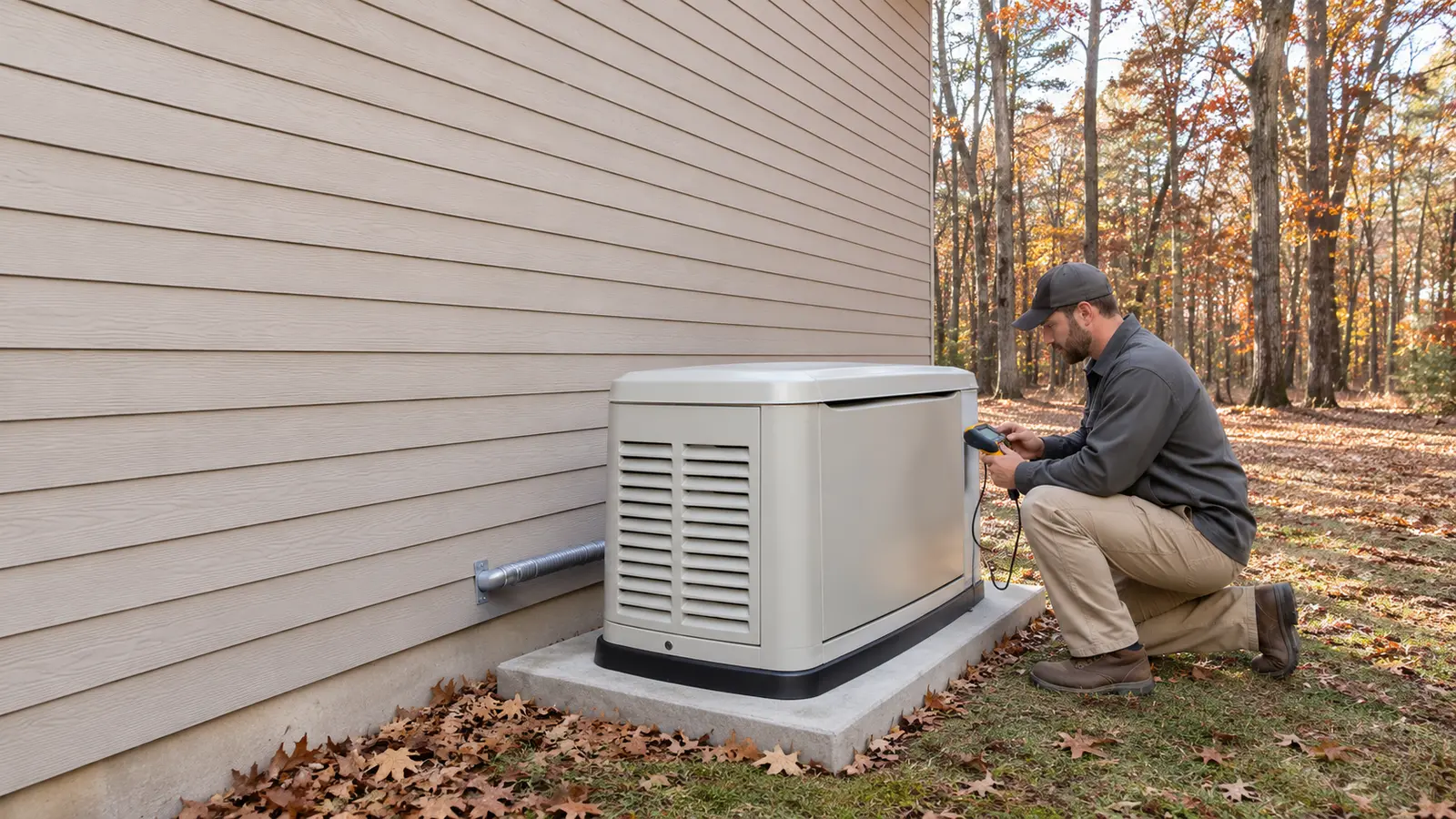
A permanently installed standby generator can be a useful feature, but a homebuyer should evaluate it as a complete system rather than assume it will power the entire house. Before closing on a home in Cherokee County, Cobb County, or nearby North Georgia, confirm what the generator serves, who owns it, how it was permitted and installed, which fuel supply it uses, whether it has been maintained, and what must transfer to the next owner.
The practical goal is not to decide whether every home needs backup power. It is to understand the particular equipment at the property, identify open questions while the contract timeline still allows follow-up, and avoid discovering after closing that “whole-house generator” meant only selected circuits or a system that has not been serviced in years.
What should a buyer check on a home standby generator?
Start with the equipment label and installation records, then connect four parts of the system: the generator, the automatic transfer equipment, the fuel source, and the circuits or loads it is designed to support. Ask for permit and final-inspection records, service invoices, warranty documents, operating instructions, and any monitoring-account details. A qualified electrician or generator technician can help evaluate installation, condition, operation, and capacity for the specific home.
1. Confirm exactly what is included in the sale
A built-in generator may look permanent, but the purchase agreement should still clearly address the generator, transfer switch, fuel tank or gas connection, monitoring equipment, battery, cold-weather accessories, remote controls, manuals, and any loose service tools. Do not rely on a listing photo or the phrase “generator ready.”
If the property uses a leased propane tank or a separate service agreement, the equipment on site may not all be seller-owned. Review invoices and contracts before assuming every component transfers. Our guide to what stays with a house in a Georgia sale explains why fixtures, accessories, and exclusions should be handled explicitly rather than through verbal assumptions.
2. Identify the model, age, fuel, and rated capacity
Photograph the model and serial number, but do not publish them in a public listing or social post. Ask for the installation date, original invoice, owner’s manual, and equipment specifications. The rating plate and manual help a qualified professional determine the fuel type, output, approved configuration, required maintenance, and intended operating conditions.
“Whole-house” is often used casually. Some systems are designed to support most or all typical loads, while others serve selected circuits through a load-management plan. Larger equipment such as heat pumps, well pumps, electric ranges, water heaters, dryers, pool equipment, and workshop tools may affect what can run at the same time. The useful question is not simply the generator’s advertised size; it is how this unit, transfer equipment, wiring, fuel supply, and actual household loads work together.
3. Verify permits and final inspections
Ask the seller for the permit number, approved scope, contractor information, and final inspection result. Requirements depend on the jurisdiction and the work performed. Cherokee County’s building-inspection guidance, for example, says permits are required for wiring and installation of mechanical equipment except specified minor repairs, and it advises owners to ask the building department when they are unsure.
A postal city does not always identify the permitting authority. Confirm whether the property is in a municipality or an unincorporated part of Cherokee or Cobb County, then contact the correct office for property-specific records. Permit approval is not a replacement for a current inspection, but missing records can signal a need for more questions about the electrical, gas, setback, pad, and installation work.
4. Understand the fuel arrangement
Residential standby generators commonly use natural gas or propane. For natural gas, ask whether the installation included any meter, regulator, line, or capacity changes and whether service documents are available. For propane, determine whether the tank is owned or leased, what else draws from it, how the line is routed, and whether delivery access and supplier arrangements are clear.
Fuel use depends on the unit, load, temperature, outage duration, and other conditions. Avoid relying on a generic “days of backup” statement. Ask the servicing company or fuel supplier for property-specific information, and review our propane-tank homebuyer checklist when a tank is part of the system.
5. Inspect the transfer equipment and covered circuits
The transfer equipment is what separates utility power from generator power and moves the home to the backup source. A buyer should not open energized panels or attempt a test alone. Ask a qualified electrician or generator technician to identify the transfer switch, show which panels or circuits are served, review any load-management modules, and explain the normal start and transfer sequence.
This is also the moment to ask what is not covered. A label may be outdated after renovations, an appliance replacement, or a panel change. If dependable operation of a well pump, medical device, home office, refrigeration, HVAC system, or other equipment matters to your plans, verify that requirement with the appropriate professionals rather than infer it from the seller’s past use.
6. Review maintenance, repairs, and recall history
Request service invoices, maintenance logs, battery-replacement dates, repair records, exercise-test settings, and the name of the company that has worked on the unit. Compare those records with the maintenance schedule in the current manufacturer instructions. Georgia Power’s generator safety guidance emphasizes following the manufacturer’s information, inspecting and maintaining the generator, and operating equipment appropriately during an outage.
Use the model and serial number to check the manufacturer’s current service information and the U.S. Consumer Product Safety Commission’s recall database. A recall search is not a condition assessment, and the absence of a recall does not prove that a particular unit is ready for service.
7. Evaluate placement, drainage, exhaust, and alarms
Look at the generator in the context of the house and lot. Note the pad, grade, drainage path, vegetation, debris, access for service, nearby openings, and any changes made since installation. Clearances and placement requirements vary by equipment and code, so compare the actual installation with the unit’s instructions and local requirements.
Generator exhaust contains carbon monoxide. The CPSC generator safety guidance warns that generators must not be operated in homes, garages, basements, crawl spaces, sheds, or near openings, and it recommends working carbon-monoxide alarms. A permanently installed unit should still be evaluated for safe siting, exhaust direction, and the home’s current alarm coverage. Never move, enclose, or modify a generator without qualified guidance.
8. Arrange a professional demonstration
Ask whether the seller will authorize a demonstration or inspection during the appropriate contract period. A qualified professional can observe the start sequence, transfer operation, sounds, vibration, leaks, fault codes, battery condition, and return to utility power. The scope should be agreed in advance, especially if testing involves an intentional service interruption.
A brief successful start is helpful but limited. It does not guarantee future performance, establish that every intended load can operate together, or replace maintenance and installation records. Document what was tested, who performed the test, and any recommended follow-up before the due-diligence deadline.
9. Plan the warranty, service, and account handoff
Before closing, determine whether the product warranty, dealer agreement, maintenance plan, fuel contract, remote monitoring, mobile app, cellular subscription, or extended coverage can transfer. Ask what forms, fees, passwords, account removal, registration, or appointment scheduling are required. The seller should remove personal access according to the manufacturer’s current process rather than share a private password.
Keep copies of the manual, service contacts, permit record, equipment specifications, and shutdown instructions where the new owner can find them. After closing, confirm monitoring alerts, exercise timing, emergency procedures, and future service dates with the appropriate provider.
Standby generator homebuyer checklist
- List every generator-related component included in the sale.
- Record the model, serial number, age, fuel type, and rated output.
- Verify the correct jurisdiction, permit, contractor, and final inspection.
- Review natural-gas capacity or propane-tank ownership, service, and access.
- Identify the transfer equipment, covered circuits, and load-management setup.
- Read maintenance, battery, repair, and recall records.
- Evaluate the pad, grade, drainage, service access, exhaust area, and CO alarms.
- Arrange an authorized professional demonstration and document the result.
- Complete warranty, monitoring, fuel, service, and account-transfer steps.
Frequently asked questions
Does a standby generator automatically add value to a home?
There is no universal value adjustment. Buyer demand, equipment condition, installation quality, capacity, age, documentation, fuel arrangement, and local comparable sales can all matter. Treat the generator as one property feature within the larger pricing and condition analysis.
Will a standby generator lower homeowners-insurance costs?
Coverage and pricing vary by insurer, property, installation, and policy. Disclose the equipment accurately and ask the insurer what documentation it needs. Buyers should obtain a property-specific quote early; our guide explains why a home-insurance quote before the due-diligence deadline can reveal questions that a general estimate misses.
Can the buyer test the generator during a showing?
Do not operate unfamiliar equipment or interrupt utility service without permission. Coordinate an authorized demonstration with the seller and an appropriate professional during the contract timeline.
What if the seller has no service or permit records?
Missing records do not establish whether the system is acceptable or defective. They do create uncertainty. Confirm the correct permitting authority, request available records, and ask qualified professionals what inspection, documentation, or corrective work is appropriate before the relevant deadline.
Make the generator part of the due-diligence plan
A standby generator is most useful when the next owner understands what it powers, how it transfers, what fuel supports it, and who will maintain it. The equipment should be reviewed alongside the home’s electrical system, insurance, fuel arrangements, inspection findings, and written purchase terms.
Buying a home with a standby generator in Cherokee County, Cobb County, or nearby North Georgia? Carol can help you organize the document requests, inspection timing, contract questions, and final-walkthrough details. Schedule a West Legacy Realty consultation.
This article provides general real-estate and consumer information, not legal, electrical, mechanical, engineering, insurance, code, fuel-supply, or manufacturer-specific advice. Equipment, permits, clearances, warranties, contracts, service requirements, and property conditions vary. Review current documents and consult the appropriate licensed professionals for the property and transaction.