
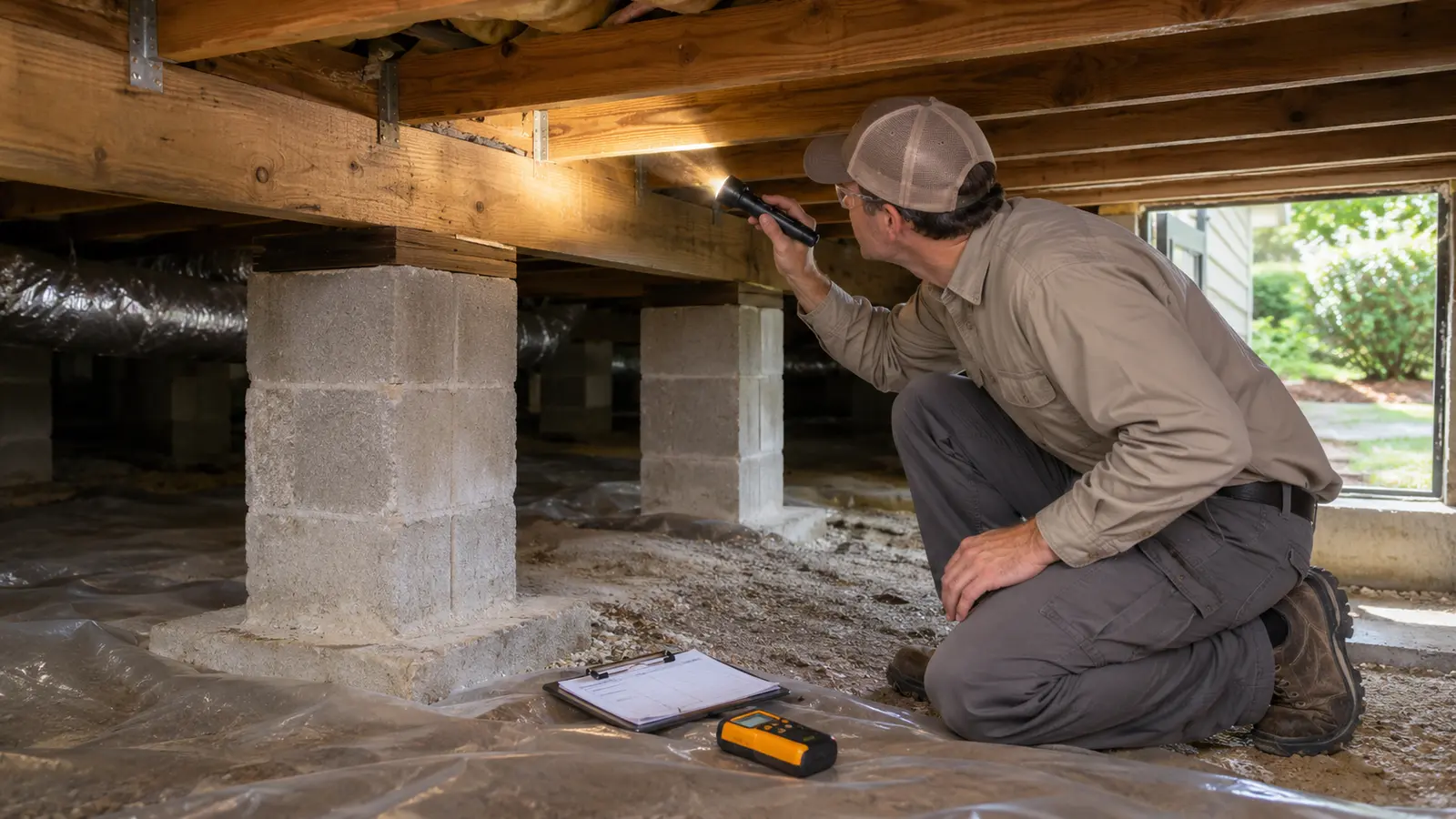
A Georgia “termite letter” can help a homebuyer understand visible evidence of certain wood-destroying organisms, prior treatment, reportable conducive conditions, and the limits of the inspection. The official name is the Georgia Wood Infestation Inspection Report, or WIIR. It is not the same as a general home inspection, and it is not a structural-engineering opinion.
For buyers in Cherokee County, Cobb County, and nearby North Georgia, the useful question is not simply, “Did the house pass?” The better questions are: Which structures were inspected? What could not be reached? Was evidence active or previous? Is damage evaluation needed? Does an existing treatment contract transfer? And do the inspection date and contract deadlines leave enough time to respond?
What is a Georgia termite letter?
Georgia’s current official form is the WIIR. According to the Georgia Department of Agriculture’s 2026 WIIR guidance, the report is used to document visible evidence of wood-destroying organisms and specified conditions conducive to infestation in a real-property transfer. It can be issued only by a licensed pest-control company licensed in the wood-destroying-organism category.
The form addresses active and previous evidence involving five categories: subterranean termites, powder post beetles, wood-boring beetles, drywood termites, and wood-decaying fungi. That is broader than termites alone, which is one reason buyers should read the entire form instead of looking for a one-line “clear” result.
1. Confirm whether your transaction calls for a WIIR
Do not assume every Georgia purchase follows the same inspection or lending requirements. Ask your real-estate professional and lender what the contract, loan program, and closing timeline require. If the parties want a WIIR, identify who will order it, when it must be delivered, and how its findings fit within the inspection and repair provisions of the contract.
This timing belongs in the broader upfront budget and due-diligence plan. First-time buyers can use our guide to planning cash to close in North Georgia to organize inspection costs, lender estimates, closing costs, and reserves without treating any one early estimate as final.
2. Verify the company and the official form
The Georgia Department of Agriculture regulates structural pest-control work and provides a license-search resource. Confirm that the company is properly licensed for wood-destroying-organism work. The current Georgia guidance says the official state WIIR is the form used for a real-property transfer; a generic company letter or a different national form is not a substitute.
Review the company name, license number, inspector, date, buyer and seller names, property address, and signatures. An incomplete form creates uncertainty at exactly the point when the buyer, lender, and closing team need a reliable shared record.
3. Check exactly which structures were inspected
The main house should be identified, along with any other structures included in the inspection. Attached decks or enclosed porches may be treated as part of the main structure, while a detached garage, workshop, pool house, shed, or other outbuilding needs to be listed if it was inspected.
Do not infer that every improvement on the parcel was covered. Compare the report with what you observed at the property and ask about any structure that is missing. This is especially important on larger North Georgia lots where detached buildings, additions, decks, or older site improvements may be easy to overlook.
4. Read “active” and “previous” findings separately
An active finding and evidence of a previous infestation are not the same. The report should distinguish them for each covered organism. If evidence is reported, the Georgia form calls for a diagram that shows where it was found and whether it is active or previous.
Ask for plain-language clarification of the location, evidence observed, and any related treatment records. A prior treatment is not automatically proof of a current problem, and a treatment date alone does not tell you whether damage was repaired, a contract remains active, or the inspected area is now accessible.
5. Study the diagram and inaccessible-area list
A WIIR is based on visible conditions in areas that were readily accessible at the time of inspection. Floor and wall coverings, siding, fixed ceilings, insulation, furniture, appliances, stored items, and other obstructions can limit what the inspector can see. The current form requires obstructed or inaccessible areas to be identified.
Pay close attention when the inaccessible list includes a crawl space, basement wall, garage, attic area, built-in storage, deck connection, or another location where wood and moisture conditions matter. Ask whether access can be improved before the due-diligence deadline and whether a return visit is appropriate.
6. Understand what “conducive conditions” means on this form
The WIIR uses a specific regulatory definition. Reportable conducive conditions are limited to certain situations, including cellulosic debris in a crawl space, untreated wood-to-soil contact, and under-floor ventilation that does not meet the referenced residential-code standard. The list is not a complete moisture, drainage, building-envelope, or maintenance evaluation.
Moisture still deserves attention. UGA Cooperative Extension explains that subterranean termites depend on moisture and often travel through protected shelter tubes. If the report, home inspection, or walkthrough shows leaks, drainage concerns, damp wood, or crawl-space moisture, determine which qualified professional should evaluate the cause and correction.
7. Separate pest findings from structural damage
The official Georgia report expressly states that it is not a structural report. A wood-destroying-organism inspector is not ordinarily expected to determine structural soundness. If active or previous evidence is reported, the form says some degree of damage should be assumed and that damage evaluation and corrective work should be handled by an appropriate building professional acceptable to the buyer and lender.
That distinction matters. Pest treatment addresses the organism; it does not by itself establish the condition or capacity of joists, sill plates, subfloor, framing, decks, or other components. Coordinate the WIIR with the broader property inspection rather than using one report as a substitute for the other. Sellers considering their own preparation can also review our guide to pre-listing home inspections in Cherokee and Cobb.
8. Review treatments, waivers, warranties, and transfer terms
If the issuing company treated the structure, the WIIR should disclose the organism, treatment date, contract expiration, and treatment type. The form also identifies whether a treatment warranty is transferable, not transferable, or absent. If an official waiver applies to a listed treatment, it should be disclosed and attached.
Ask for the underlying contract, treatment proposal, service records, renewal terms, transfer fee, coverage limits, exclusions, and renewal date. Do not describe a retreatment agreement as a repair warranty unless the documents actually say that. The Georgia Department of Agriculture’s consumer guidance notes that structural pest-control services require contracts and that service records include the treatment details and technician information.
9. Build the findings into the contract timeline
A useful report still needs a transaction plan. Track the inspection date, due-diligence deadline, lender requirements, access for follow-up specialists, treatment proposals, damage evaluations, repair documentation, warranty-transfer steps, and the final walkthrough. Put agreements in writing through the appropriate contract process.
The Georgia form includes a limited 90-day treatment guarantee when a covered infestation from which apparent freedom was certified is found after issuance. That guarantee is not a promise that every area was visible, that no damage exists, or that structural repairs are included. Read the current form and the specific treatment contract instead of relying on the shorthand phrase “termite clearance.”
If the home is newly built, coordinate pest documentation with the items in our new-construction final-walkthrough checklist. New construction can still involve wood-to-soil clearance, treatment documentation, grading, moisture, access, and warranty questions.
Georgia termite letter checklist for buyers
- Confirm the contract and lender requirements, ordering responsibility, cost, and deadline.
- Verify the company’s Georgia license and use of the current official WIIR.
- Match the listed main and other structures to what is actually on the property.
- Read active and previous findings separately for all five covered organism categories.
- Review the diagram and every obstructed or inaccessible area.
- Note the form’s limited definition of reportable conducive conditions.
- Order an appropriate structural or building evaluation when damage may be present.
- Read treatment records, waivers, warranty coverage, transfer terms, fees, and expiration dates.
- Coordinate follow-up, written agreements, lender needs, and the final walkthrough before deadlines expire.
Frequently asked questions
Is a Georgia termite letter the same as a home inspection?
No. The WIIR addresses specified wood-destroying organisms, certain visible evidence, and narrowly defined conducive conditions. It is not a full home inspection or a structural report.
Does a report with no visible evidence mean the home has never had termites?
No. The report is based on the covered structures, accessible areas, records available to the issuing company, and conditions observed at the time. Read the previous-infestation section, treatment history, inaccessible-area list, and report limitations.
Who pays for the WIIR or any treatment?
That can depend on the contract, loan requirements, negotiations, and the service ordered. Confirm responsibility in writing instead of relying on a local custom or verbal assumption.
Does a termite warranty automatically transfer to the buyer?
No. The WIIR should indicate whether the issuing company’s treatment warranty is transferable, but the buyer still needs to review the underlying contract, fee, deadline, coverage, and renewal requirements.
Turn the report into a clear due-diligence plan
A Georgia termite letter is most useful when buyers read its scope and limits, connect the findings to the right specialists, and leave time for follow-up. The goal is not a vague “pass” or “fail.” It is a documented understanding of what was inspected, what was observed, what remains unknown, and what the parties will do next.
Buying a home in Cherokee County, Cobb County, or nearby North Georgia? Carol can help you coordinate inspection timing, document requests, follow-up questions, and the final-walkthrough plan. Schedule a West Legacy Realty consultation.
This article provides general real-estate and consumer information, not legal, lending, structural, engineering, pest-control, or pesticide advice. Requirements, contracts, property conditions, treatment methods, warranties, and loan programs vary. Review current documents and consult the appropriate licensed professionals for the property and transaction.