
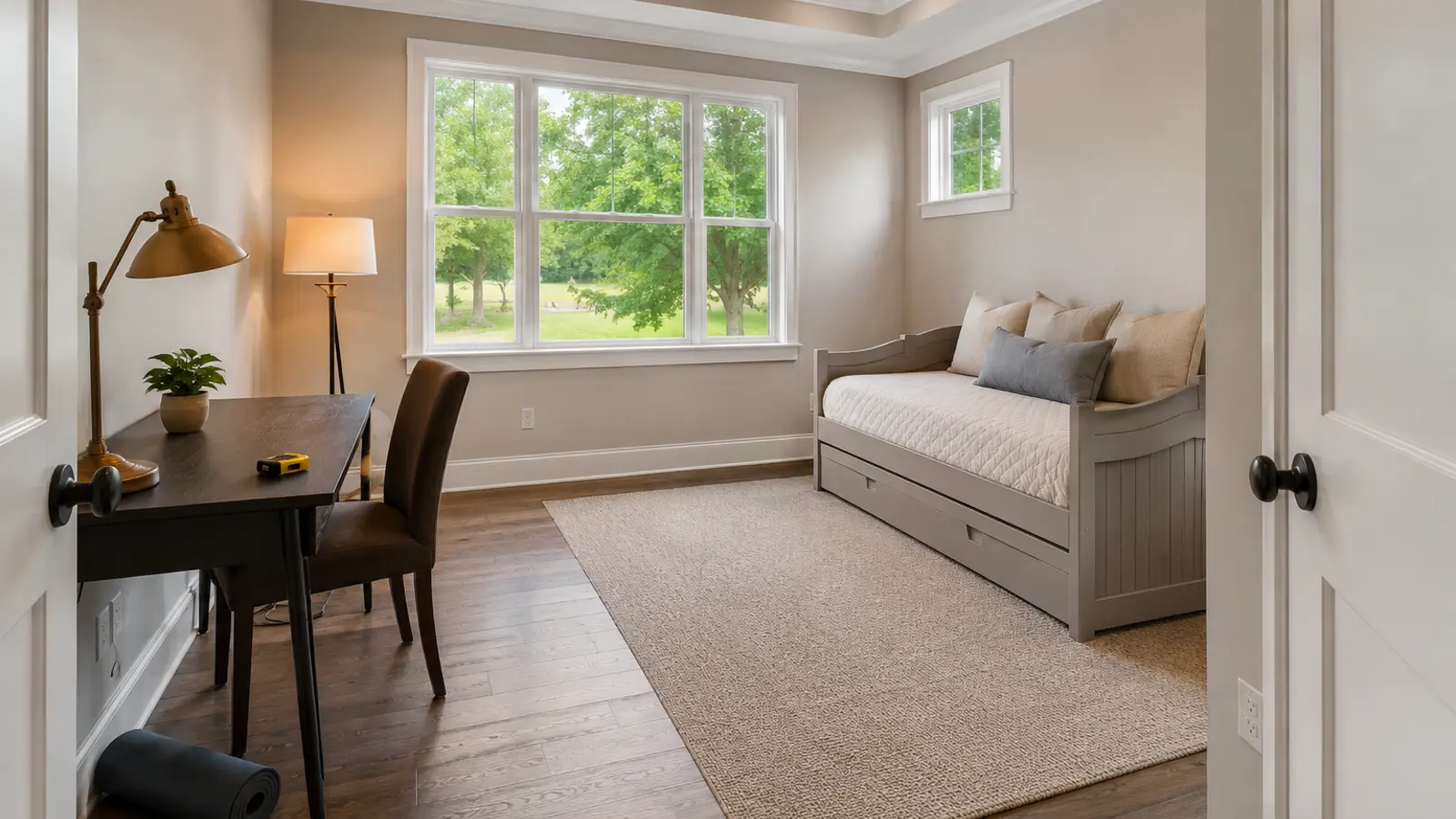
A room labeled “office,” “bonus room,” or “flex space” only helps if it works for the jobs you actually need it to do. Before buying a home in Cherokee County or Cobb County, test the room with real measurements, real routines, and a backup use. A seven-part check can expose layout problems that a quick showing may hide.
Start by writing one primary job and one secondary job for the room. Then test furniture fit, privacy, light, power and connectivity, storage, circulation, and the effort required to change uses. You are not trying to find a perfect room. You are deciding whether its trade-offs fit your day-to-day life.
Need help turning your room requirements into a focused search? Talk with Carol about your Cherokee County, Cobb County, or North Georgia move.
Why a flex-room label is not enough
Listing language describes possibilities, not performance. The same room might serve beautifully as a quiet workspace but feel cramped as a guest room. Another may fit exercise equipment but sit directly in the main traffic path.
This matters when comparing homes with different floor plans. A larger room is not automatically more useful. Door swings, window placement, ceiling angles, closets, vents, and the route through the space can make a smaller room easier to use.
Use this 7-part flex-room test before buying
1. Name the room’s two most important jobs
Choose a primary use and a realistic backup use. Examples might include workspace plus occasional guest room, hobby room plus homework space, or exercise room plus storage. Avoid giving one room five equal responsibilities. That usually produces a list of furniture that cannot coexist.
For each use, note what must remain set up and what can be folded, stored, or moved. A room that works only after a major reset may not be as flexible as it first appears.
2. Measure usable floor area, not just wall-to-wall dimensions
Bring the measurements of the desk, sleeper sofa, shelving, exercise equipment, or other pieces that matter. At the property, account for baseboards, door swings, closet access, windows, vents, and the space needed to pull out a chair or open a guest bed.
Painter’s tape can help after closing, but during a showing a tape measure and a simple furniture sketch are enough. Mark the fixed features first. Place furniture around them, then check whether the remaining path still feels comfortable.
3. Test privacy and sound from the adjoining rooms
Stand inside the flex room while someone speaks at a normal volume in the hallway or nearby living area. Close the door if there is one. Notice shared walls, open railings, wide cased openings, and whether the room sits beside the kitchen, laundry, or main gathering space.
The right level of separation depends on the job. Video calls and overnight guests usually need more privacy than crafts or casual reading.
4. Check light, glare, and comfort at the time you will use it
Natural light can be valuable, but window direction and furniture placement affect screen glare and room temperature. Look for blinds or shades, overhead lighting, task-light locations, HVAC supply and return vents, and ceiling fans when present.
A single showing captures only one time of day. If the room is important to your decision, ask what you can verify through another visit, photos taken at a different time, or a careful review of the window orientation.
5. Count power and connectivity needs before planning the layout
Locate outlets instead of assuming furniture can go anywhere. Make a rough count for computers, monitors, lamps, chargers, exercise equipment, or hobby tools. Long extension cords across a walkway are a clue that the planned layout needs another solution.
For internet-dependent uses, ask how the home is currently served and where networking equipment is located. Service and performance vary by address and setup, so verify the options that matter to you rather than relying on a general neighborhood assumption.
6. Find a home for the room’s “changeover” items
A flexible room needs somewhere to put bedding, folding equipment, files, supplies, or the chair that moves when a guest bed opens. Check closet dimensions, door clearance, shelving, and nearby storage.
If changeover items must live in another part of the house, walk that route. A plan that looks tidy on paper can become inconvenient when heavy or bulky items move up stairs every week.
7. Walk the circulation path with the room in both modes
Imagine the room fully set up for its primary use, then for its backup use. Can someone enter, reach the closet, open a window, and move past the largest piece of furniture? Does using the room block access to another bedroom, bathroom, porch, or storage area?
Finish by rating the room from 1 to 5 for fit, privacy, comfort, utilities, storage, and changeover effort. Use the same scorecard at every property. Consistent notes make it easier to compare a polished room with a less-staged space that may actually work better.
Compare the room in the context of the whole home
A flex room should support the rest of the floor plan, not compensate for several unrelated problems. If it must become an office, guest room, play area, storage room, and exercise space because the home lacks alternatives, decide which functions are truly non-negotiable.
That same practical approach can help with the location. Run the five-day life test for a Cherokee or Cobb County address so the home’s rooms and its daily routes are evaluated together. Buyers considering a smaller or easier-to-manage property can also use the seven-decision downsizing plan to connect space choices with maintenance and move timing.
Questions to ask while touring a flex space
- What is the room’s primary job on a normal weekday?
- What furniture must stay in place?
- Which doors, closets, windows, and vents cannot be blocked?
- How much privacy does the intended use require?
- Where will changeover items be stored?
- What would need to change before the room works as planned?
Build the flex-room test into your home search
A useful search plan goes beyond bedroom count and square footage. It turns your routines into property-specific questions, so each showing gives you information you can compare.
If a flexible room is important to your move, Carol can help you define the right criteria and use a consistent scorecard while touring homes in Cherokee County, Cobb County, and North Georgia. Request a local home-search consultation with Carol and bring the room uses, furniture measurements, and trade-offs that matter most to you.