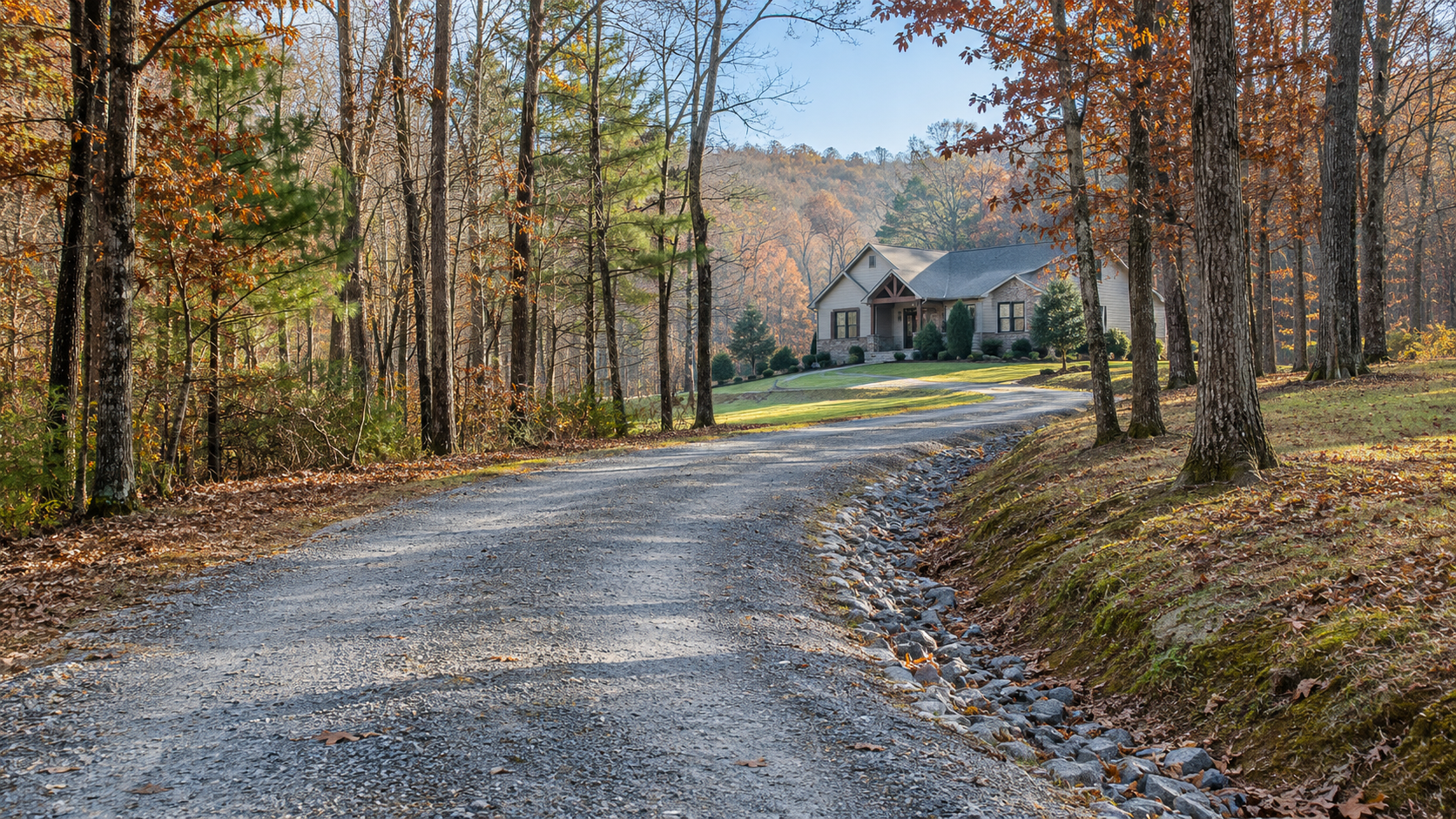
Yes, a home on a private road can be a practical North Georgia purchase, but the road needs its own due diligence. Before you offer, confirm who owns and maintains the road, whether the property has recorded access, how costs are shared, what your lender requires, and whether the road works for ordinary vehicles, deliveries, utilities, and emergency response.
This matters in Cherokee County, Cobb County, and nearby North Georgia communities where one driveway or lane may serve several homes. A road can look public on a map, feel private at the gate, or appear well maintained during one showing. None of those observations tells you the full legal or financial story.
Use these nine checks to turn “private road” from a vague listing detail into a documented part of your home-buying decision.
1. Verify whether the road is publicly or privately maintained
Start with the road itself: Is it a county-maintained road, a city street, an HOA-owned private street, a shared driveway, or a road crossing land owned by one or more neighbors?
Do not rely only on pavement, a street sign, an online map, or a mailing address. Cherokee County says its road-maintenance maps are maintained from recorded subdivision plats, commission-approved resolutions, and information from Roads and Bridges. That makes the county GIS and the appropriate roads department useful starting points for an address-specific check.
Cobb County’s published GIS specifications also offer a useful warning: some mapped road and pavement data do not determine whether a road is public or private. Use maps to orient your research, then verify maintenance status with the correct local department and the property documents.
2. Ask the closing attorney and title provider to review legal access
A physical path to the house is not the same thing as a clear legal right to use that path. Ask for the recorded documents that establish access from the property to a public road. Depending on the property, those may include a deed, plat, access easement, reciprocal easement, subdivision declaration, or road agreement.
The review should be property-specific. Which parcel is burdened by the access? Which parcel benefits? Is the easement wide enough for the actual road? Does it run with the land and bind future owners? Are gates, parking, widening, utilities, or commercial use addressed? A Georgia real estate attorney and title professional can explain what the recorded documents mean for the purchase.
This is also where a current survey may add useful context. See our guide to deciding whether you need a property survey before buying in Cherokee or Cobb.
3. Read the road-maintenance agreement, not just the listing remarks
If several owners use the road, ask whether a written maintenance agreement exists. Read the actual document and compare it with what happens in practice.
Useful questions include:
- Who decides when grading, gravel, paving, drainage, tree work, or repairs are needed?
- How are expenses allocated: equally, by road frontage, by distance, or by use?
- Is there a reserve fund or are owners billed when work occurs?
- Who hires contractors and approves the scope?
- What happens when an owner does not pay or disagrees with the work?
- Do the responsibilities transfer to future owners?
If there is no written agreement, that is a fact to understand before you commit. Ask the closing attorney, lender, and insurance professional what additional documentation or review may be appropriate.
4. Involve your lender early
Loan-program and underwriter requirements can differ. Send the road, easement, title, and maintenance documents to your lender early enough to avoid a late closing surprise.
For example, current USDA guaranteed-loan guidance says a private road or shared driveway must provide access and generally requires a permanent recorded easement or qualifying HOA maintenance arrangement, subject to lender review. That does not mean every loan follows the same rule. It shows why “the neighbors have always used it” is not a substitute for program-specific underwriting.
Ask your lender what must be documented, who must approve it, and when the review needs to be complete. If you are still planning your purchase funds, pair this step with our first-time buyer cash-to-close guide.
5. Drive the full route and inspect the surface
Walk or drive the route with permission. Note the surface material, width, grade, turnarounds, bridges or culverts, overhead limbs, blind curves, potholes, washboarding, loose gravel, erosion, and soft shoulders. Consider how the road would function for the vehicles you actually use, not only the vehicle you brought to the showing.
Visit after ordinary rain when conditions allow. A dry-weather showing may not reveal standing water, rutting, runoff, or a muddy section. If the route is steep, narrow, or long, ask how owners handle storms, fallen trees, ice, and seasonal maintenance.
A licensed home inspector may comment on visible site conditions near the home, but specialized road, drainage, bridge, retaining-wall, or engineering questions may need the appropriate qualified professional.
6. Follow the water
Private-road costs are often tied to water management. Look for ditches, crowns, swales, culverts, outlets, sediment, washouts, and places where runoff crosses the road or enters a driveway.
Ask who maintains each drainage feature and whether any of it lies within an easement. Cherokee County notes that it does not maintain private property or drainage easements beyond the public right of way. Responsibility will depend on the location, documents, and local rules, so verify rather than assume the county will repair a private feature.
7. Test everyday access and services
A private road affects more than your commute. Verify how the address works for:
- trash and recycling pickup;
- mail and package delivery;
- school-bus stops;
- propane, moving, septic, well, and construction trucks;
- internet and utility installation or repair;
- guests, caregivers, contractors, and larger vehicles.
Ask service providers directly about the specific address. A neighbor’s setup may not be available to the home you are considering. This is especially important for utilities that cross other parcels or require a new trench, pole, line, or service agreement. Our North Georgia internet-verification checklist can help with that part of the review.
8. Confirm the official address and emergency-access details
Make sure the official address, road name, mailbox location, driveway entrance, and mapping pin point responders and visitors to the correct place. Cherokee County GIS explains that residential addressing is administered through the county and asks owners to contact GIS when an address is out of sequence or building access changes.
For a property behind a gate or down a long shared lane, ask about gate access, visible address markers, turnarounds, and any local fire or emergency-access requirements. Do not make your own safety determination from a map. Confirm address-specific questions with the appropriate county or city offices and qualified professionals.
9. Put the road into your long-term ownership plan
Finally, treat the road as an ongoing property feature. Review past maintenance invoices, current condition, expected work, owner participation, and any unresolved disputes disclosed through the transaction. Ask your insurance professional whether the road, bridges, gates, shared structures, or liability questions change the coverage review for this property.
Then consider future marketability. Another buyer and lender may ask for the same documents you are reviewing now. Organized records, clear access, and a workable maintenance structure can make those conversations easier, while uncertainty may add time or cost.
For broader property-specific planning, review our guide to getting a home insurance quote before due diligence ends.
A practical private-road buyer checklist
- Confirm public or private maintenance with the correct jurisdiction.
- Obtain the deed, plat, easements, title work, and road agreements.
- Have the closing attorney and title provider explain legal access.
- Send private-road documents to the lender early.
- Review maintenance duties, cost sharing, reserves, and enforcement.
- Drive the route and evaluate grade, width, surface, turnarounds, and structures.
- Inspect drainage and clarify responsibility for ditches and culverts.
- Verify deliveries, utilities, services, addressing, and emergency access.
- Estimate ongoing costs and keep the documents for a future sale.
Frequently asked questions
Can a lender finance a home on a private road?
Potentially, yes. Approval depends on the property, loan program, access documents, maintenance arrangement, road condition, appraisal, title review, and lender underwriting. Provide the documents early and ask your lender for property-specific requirements.
Does a county maintain a road because it has a street sign?
Not necessarily. Signs, addresses, pavement, and map labels do not by themselves prove public maintenance. Verify the road segment with the relevant city or county department and compare that answer with the recorded property documents.
Is a shared driveway the same as a private road?
The labels are sometimes used loosely, but the recorded documents and physical arrangement control the practical questions. Confirm who owns the land, who has access, who maintains the surface and drainage, and what your lender and title provider require.
Make the road part of the offer strategy
A private road may support the setting, privacy, or lot layout you want. The smart move is to evaluate it with the same care you give the house: document the access, understand the maintenance plan, test the physical route, and coordinate the lender, attorney, title provider, inspector, insurance professional, and local offices before your deadlines.
Carol can help you organize those questions around the property, contract timeline, and North Georgia home search. Schedule a consultation with West Legacy Realty before you write an offer on a private-road home.
This article provides general real-estate education, not legal, lending, title, insurance, engineering, surveying, or safety advice. Access rights, road ownership, maintenance duties, county records, loan requirements, insurance considerations, and property conditions vary. Consult the appropriate qualified professionals for the property and transaction.